
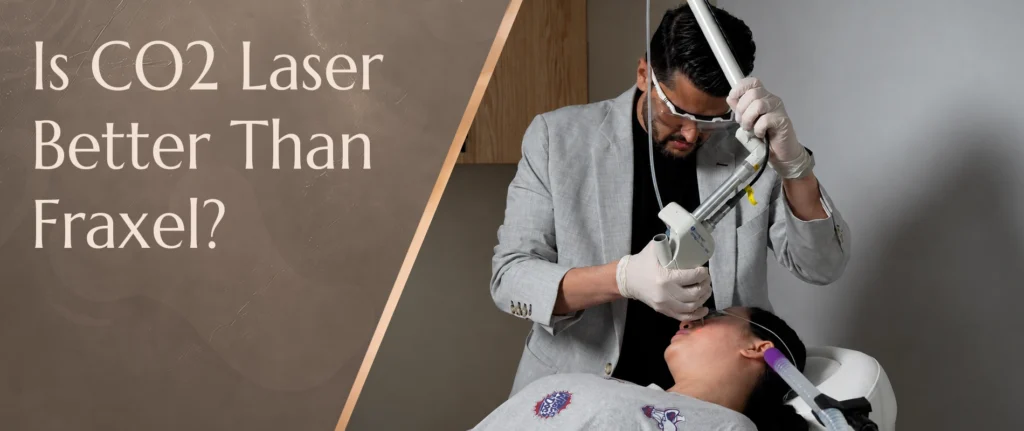
If you are comparing CO2 vs Fraxel laser, the better treatment depends on what you want to improve, your skin type, and how much downtime you can manage. CO2 laser resurfacing is generally more intensive and can be useful for deep wrinkles, acne scars, significant sun damage, and advanced skin texture concerns. Fraxel usually takes a gentler approach, making it suitable for fine lines, pigmentation, mild-to-moderate acne scars, and uneven skin texture. The treatments also differ in their recovery time, number of sessions, and potential risks. For patients searching for the best laser resurfacing for the face, “better” therefore does not always mean stronger. The right choice should match the depth of the skin concern with an appropriate level of treatment.
What Is the Difference Between CO2 Laser and Fraxel?
The biggest difference between Fraxel vs CO2 laser is how aggressively each technology resurfaces the skin. Fraxel laser treatment at Reveal Clinics uses non-ablative fractional laser technology, creating controlled microscopic treatment zones while preserving much of the surrounding tissue. This stimulates collagen production, skin renewal, and collagen remodeling without removing the entire surface layer. In contrast, an Ultra Pulse Fractional CO2 Laser at Reveal Clinics is an ablative fractional laser designed to remove microscopic areas of damaged surface tissue while delivering energy deeper into the skin. That deeper resurfacing can create a stronger remodeling response but normally requires more recovery. This distinction between ablative vs non-ablative laser resurfacing explains many of the differences in results, downtime, and suitability.
CO2 Laser vs Fraxel: Comparison Table
The table below highlights the key differences between CO2 laser vs Fraxel, including treatment depth, downtime, recovery, results, skin concerns, number of sessions, and skin tone suitability. It offers a quick way to compare which laser resurfacing treatment may better match your skin goals.
| Comparison Factor | CO2 Laser | Fraxel |
|---|---|---|
Laser type |
Ablative fractional laser |
Non-ablative fractional laser |
Treatment intensity |
More intensive |
Gentler |
Treatment depth |
Can provide deeper skin resurfacing |
Controlled fractional treatment without aggressive surface removal |
Best for |
Deep wrinkles, advanced texture concerns, deeper acne scars, significant sun damage |
Fine lines, pigmentation, mild-to-moderate scars, uneven tone and texture |
Results |
Often more noticeable after an appropriate treatment |
More gradual and progressive |
Sessions |
Often fewer treatments |
Commonly performed as a series |
Downtime |
Longer |
Shorter |
Recovery |
More intensive healing |
Generally faster |
Skin tightening |
Greater resurfacing and remodeling potential |
More modest tightening |
Pigmentation concerns |
Requires careful patient selection |
Often offers more flexibility depending on wavelength and settings |
Darker skin tones |
Higher caution due to PIH risk |
May be suitable with carefully selected settings |
Best for minimal downtime |
Usually no |
Usually yes |
Best for dramatic resurfacing |
Often yes |
Better for progressive improvement |
CO2 Laser vs Fraxel for Acne Scars
For acne scar laser treatment, the type and depth of the scar matter more than simply choosing the strongest laser. A fractional CO2 laser for scars can create deeper controlled remodeling and may be considered when acne scars are pronounced or when substantial textural correction is required. Fraxel can be appropriate for mild-to-moderate acne scarring, particularly when the patient prefers less downtime and gradual improvement. Different scar patterns, including rolling, boxcar, and ice-pick scars, do not respond identically, so no single face laser is automatically best for every scar. Deeper scars may also need a broader treatment strategy rather than laser alone. A clinical skin assessment is therefore essential before deciding whether Fraxel or CO2 for acne scars is more appropriate.
CO2 Laser vs Fraxel for Wrinkles, Pigmentation, and Skin Texture
Patients looking for the best laser for wrinkles or the best laser for deep wrinkles may benefit more from CO2 resurfacing when lines are deeply etched and accompanied by significant texture changes. The stronger thermal and ablative effect can promote substantial collagen remodeling and improvement in surface irregularities. Fraxel, however, is frequently selected for early aging, fine lines, sun damage, age spots, uneven pigmentation, and rough texture, especially when a patient wants gradual rejuvenation. This makes Fraxel relevant when searching for the best laser facial for early aging or a treatment offering less interruption to everyday activities. Neither device should automatically be called the most effective laser treatment for the face without assessing the concern being treated. Effectiveness depends on the treatment objective rather than laser strength alone.
Fraxel vs CO2 Laser: Downtime and Recovery
Fraxel downtime is generally shorter because surrounding untreated skin helps the microscopic treatment areas heal more quickly. Patients commonly experience temporary redness, swelling, dryness, bronzing, or light flaking after treatment, with social downtime generally measured in days rather than an extended recovery period. CO2 laser recovery is more involved because ablative resurfacing creates a greater wound-healing response. Redness, swelling, peeling, crusting, sensitivity, and prolonged pinkness may occur depending on treatment intensity and individual healing. This is the principal trade-off when comparing minimal downtime lasers with more aggressive resurfacing technologies. Fraxel may therefore fit a busy lifestyle more easily, while CO2 may suit someone willing to accept greater recovery in exchange for potentially stronger resurfacing.
Which Is Safer for Darker Skin Tones?
Skin tone compatibility is especially important when considering laser resurfacing because both treatment energy and treatment density affect pigment response. People with darker or pigmentation-prone skin can have a greater risk of post-inflammatory hyperpigmentation (PIH) after thermal injury, particularly following ablative resurfacing. Fractional non-ablative treatments can be used in darker skin types with appropriately selected settings, while fractional CO2 requires careful candidate selection and individualized parameters. Research on skin of color similarly emphasizes that fractional non-ablative lasers can be used in Fitzpatrick III–VI skin when treatment settings and supportive care are carefully selected. This does not mean Fraxel is automatically risk-free or that CO2 cannot be used in darker skin. Fitzpatrick skin type, tanning history, pigmentation tendency, treatment density, and aftercare all need to be considered.
CO2 Laser vs Fraxel Side Effects and Risks
Both laser and skin treatments can cause expected short-term reactions such as redness, swelling, sensitivity, and temporary pigment changes. Fraxel usually creates a lower surface-injury burden, although hyperpigmentation, prolonged redness, irritation, infection, or rare scarring remain possible. Ablative CO2 resurfacing carries a more intensive recovery and can involve oozing, crusting, longer-lasting redness, pigment changes, infection, and scarring if healing is disrupted. Evidence from fractional CO2 treatment also shows that post-inflammatory hyperpigmentation deserves particular attention in darker skin phototypes. Careful treatment settings and disciplined post-treatment aftercare are therefore as important as the device itself. Choosing an appropriately qualified medical professional is a fundamental part of reducing avoidable complications.
How Many Sessions of CO2 Laser or Fraxel Are Needed?
Another significant difference in Fraxel vs CO2 laser is how treatments are typically planned. Fraxel is commonly performed as a series because each session treats controlled fractional zones and produces progressive collagen stimulation rather than maximally aggressive resurfacing at once. The number of sessions varies according to pigmentation, wrinkles, scars, texture, laser wavelength, treatment density, and individual response. Fractional CO2 may create a greater change after fewer treatments because it produces both surface ablation and deeper thermal remodeling. However, a patient with severe scarring may still require more than one procedure or complementary treatment. The goal should not be the fewest sessions possible, but the safest treatment plan capable of producing meaningful improvement.
How Long Do CO2 Laser and Fraxel Results Last?
Both treatments can produce improvements that continue developing after the initial recovery because collagen remodeling occurs gradually. Fraxel patients may notice progressive changes in skin tone, texture, fine lines, and acne scars over the weeks and months following a treatment series. CO2 resurfacing can also continue improving as new collagen forms and the skin remodels after deeper treatment. Results from either procedure are not permanent because natural aging, UV exposure, lifestyle factors, and new skin damage continue over time. Good skincare and consistent sun protection can help preserve the improvement achieved. Maintenance needs differ between patients, so it is more accurate to discuss longevity of laser results individually rather than promise a fixed number of years.
Which Laser Is Better for You?
Fraxel is often the more suitable choice when your concerns include early wrinkles, mild acne scars, pigmentation, enlarged pores, or uneven texture and you want manageable recovery. It can also appeal to patients searching for minimal downtime lasers or a full face laser treatment that provides progressive rather than aggressive resurfacing. CO2 may be more appropriate when the primary concerns are deep wrinkles, significant acne scarring, advanced sun damage, or pronounced textural changes and stronger correction is the priority. Someone looking for the best CO2 laser for wrinkles should still be assessed for skin type, healing history, and pigmentation risk before treatment. Your tolerance for downtime is equally important because stronger treatment is not advantageous if recovery cannot be managed properly. The best option is therefore the treatment offering the right balance between benefit, recovery, and safety.
CO2 Laser vs Fraxel in Riyadh: What to Consider
When choosing CO2 laser vs Fraxel in Riyadh, sun exposure and pigmentation risk deserve particular attention before and after resurfacing. Recently treated skin is more vulnerable to UV-related pigment changes, so consistent broad-spectrum sun protection and following medical aftercare instructions are particularly important. Patients should also avoid planning aggressive treatment immediately before periods when significant sun exposure cannot realistically be avoided. For people who already experience melasma, dark spots, or post-inflammatory pigmentation, laser selection may require a more conservative approach. Riyadh patients should therefore focus not only on finding the best skin resurfacing technology but also on choosing treatment parameters suitable for their complexion and lifestyle. A personalized consultation can determine whether Fraxel, fractional CO2, or another approach better matches the desired result.
Why Consult Dr. Saud Al-Obaida for CO2 Laser and Fraxel in Riyadh?
For patients considering advanced laser skin resurfacing in Riyadh, treatment planning with an experienced dermatologist is important because device settings must be adjusted to the individual rather than applied as a standard protocol. Dr. Saud Al-Obaida at Reveal Clinics is a Consultant in Dermatology, Laser & Aesthetic Injections at Reveal Clinics and holds Canadian and American dermatology board certifications following dermatology training at the University of British Columbia. His work includes laser skin rejuvenation, acne and acne scar treatment, pigmentation, melasma, and skin tightening, making a consultation relevant when deciding between Fraxel and fractional CO2. The assessment can consider skin type, scar depth, pigmentation history, downtime, and treatment goals before recommending a protocol. This individualized approach is especially valuable when treating pigmentation-prone or darker skin. Treatment suitability and expected results should always be established through an in-person medical assessment.
Frequently Asked Questions (FAQ)
Is CO2 laser more effective than Fraxel?
CO2 can be more effective for deep wrinkles, advanced texture damage, and deeper scars because it provides more intensive resurfacing. Fraxel may be better when concerns are milder and shorter downtime is a priority.
Is CO2 laser better than Fraxel for acne scars?
For deeper or more established acne scars, fractional CO2 may provide stronger remodeling. Fraxel can improve mild-to-moderate scars, but the best treatment depends on the scar type, depth, skin tone, and pigmentation risk.
Which is better for pigmentation, Fraxel or CO2 laser?
Fraxel is frequently considered when the main concerns are sun damage, uneven pigmentation, and age spots, particularly when less aggressive resurfacing is preferred. CO2 can improve pigmentation but requires more careful patient selection.
Which has more downtime, Fraxel or CO2 laser?
CO2 laser downtime is generally longer because it removes microscopic areas of surface tissue. Fraxel recovery is usually shorter because its non-ablative fractional approach preserves the skin surface to a greater extent.
Is Fraxel safer than CO2 laser for darker skin?
Fraxel may offer more flexibility for some darker skin tones, but neither treatment is automatically suitable for everyone. Fitzpatrick skin type, PIH history, wavelength, density, and treatment settings must be evaluated first.
Which treatment lasts longer, CO2 laser or Fraxel?
CO2 can produce substantial long-term improvement after deeper resurfacing, while Fraxel often relies on a treatment series and periodic maintenance. The longevity of both depends heavily on aging, sun exposure, skincare, and lifestyle.
Can Fraxel and CO2 laser be combined?
They may be used strategically within a staged treatment plan when different skin concerns require different resurfacing depths. Combination treatment should only follow a medical assessment because recovery, skin tone, and pigmentation risk influence the safest sequence.
Conclusion
So, is CO2 laser better than Fraxel? It can be better when the goal is more intensive correction of deep wrinkles, substantial acne scars, advanced photoaging, or pronounced skin texture changes, and the patient can accommodate a longer recovery. Fraxel may be better for early aging, pigmentation, mild-to-moderate scarring, fine lines, and gradual facial rejuvenation with less downtime. In other words, CO2 is generally the stronger resurfacing option, but stronger does not automatically mean more appropriate. The best laser resurfacing for the face should match the treatment depth to your skin rather than follow a one-size-fits-all ranking. Skin tone and the risk of post-inflammatory hyperpigmentation are particularly important when making this decision. A personalized assessment at Reveal Clinics in Riyadh can help determine which technology provides the most appropriate balance of results, safety, and recovery for your skin.
This version uses only Fraxel and Ultra Pulse Fractional CO2 Laser as device-service links because they are directly relevant to the search intent; adding M22 IPL, Excel V+, Splendor X, Ultherapy, or unrelated services here would weaken topical focus.